Showing posts with label Statues. Show all posts

February 23, 2013

A Hidden Statue

Back in November, my darling little brother came to visit me. We meet up in Paris and spent the weekend.

While cutting through the jardin de Luxembourg, I suddenly remembered that the statue of liberty has a second residence there. Or at least, I thought I remembered there being a copy of her statue, and was pretty sure it was in the Luxembourg gardens.

So we checked out the directory. There was no mention of it. But I wasn’t going to let some silly, not very precise map be the end-all-be-all of statue of liberty locations.

Luckily just then, a rather cute twenty something Parisian gentlemen happened upon our path. I asked him about the statue.

He was in agreement with the directory.

I was in disagreement with both of them.

My brother was growing impatient, and seemed ready to give up on our quest, when I saw them; an elderly couple going for a leisurely stroll through the park. And I knew that they knew because, as I said to my brother, “old people know things.”

“Excusez-moi? Bonjour” (Excuse me? Hello)

“Bonjour…” (Hello…)

“Desolée de vous derangez, mais je voulais savoir si vous savez pour la statue-“ (Sorry to bother you, but would you happen to know where the statue-)

She didn’t even let me finish my question.

“Ah oui, tout le monde veux la voir. Elle est juste là, à gauche, derière les joeurs de pétanque.” (Oh yes, everybody wants to see her. She’s just over there, on the left, behind the bocce ball players).


Little brother and I with Lady Liberty herself!

Following her flawless directions, my brother and I saw the tiny version of the Statue of Liberty. Not a common tourist destination to be sure, but the important thing to remember is that I was right!

March 31, 2012

La Déesse

In the beginning of the First French Republic, many countries challenged the authenticity of this new government and saw it as an opportunity to take over parts of France. Lille was subjected to attack from Austria in 1792. After several days of cannon fire, Lille won the battle.

To commemorate Lille's victory, a statue was erected in the Grand'Place (or la place du Général-de-Gaulle) in 1845. The statue is known as La Déesse (the goddess) because of her mural crown. Her left hand points to an inscription of the Mayor at the time's refusal to surrender the city.


Lillois enjoying the sun while sitting around La Déesse.


She is meant to watch over and protect Lille. She holds in her right hand a boutefeu, a stick with which one ignites a cannon.


A close up on La Déesse and her boutefeu, as well as the top of the tower of the Chambre de Commerce.


Although originally just a column in the middle of the square, La Déesse is now surrounded by a beautiful fountain. She is a meeting place for many a rendez-vous in the city center, as well as big cultural events (like when Lille won La Coupe de France). If you stop by during la rentrée (the return to school) in September, you will often find college freshmen plunging themselves in the fountain.


La Déesse and her fountain in the center of la Grand'Place.


It's a great place to stop, sit, and enjoy the beautiful Flandres architecture that surrounds la Grand'Place. Especially when the weather is nice.

Check it out:
Place du Général-de-Gaulle, otherwise known as la Grand'Place

February 6, 2012

Statue: Mon P'tit Quinquin

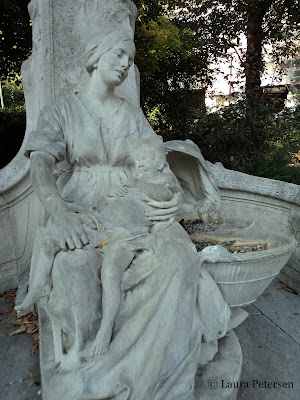
In Lille, there is a statue dedicated to the Northern lullaby “P’tit Quinquin” and its author Alexandre Desrousseaux.


Lillois soaking up the sun at the statue dedicated to Desrousseaux and his famous song.


Desrousseaux was a 19th century poet born in Lille who wrote in both French and Ch’ti.

His most well-known and well-loved song is L'canchon Dormoire, more commonly referred to as mon p’tit quinquin. It’s a lullaby that has become Lille's unofficial city anthem.

Here’s the famous refrain (en ch’ti):
Dors min p'tit Quinquin,
Min p'tit pouchin,
Min gros rojin ;
Te m'f'ras du chagrin,
Si te n'dors point j'qu'à d'main.


Which translates to:
Sleep my little baby
My little chick
My fat grape
You will fill my heart with sorrow
If you don’t sleep until the ‘morrow


The statue features the bust of Desrousseaux as well as a woman singing her child to sleep, the embodiment of his famous lullaby.


The lullaby is feautured in Bienvenue Chez Les Ch'tis. When Dany Boon and Kad Merad are drunkenly visiting all the homes along their postal route, an elderly woman sings them this song, bringing them all to tears.

Check it out:
Rue Nationale entrance to square Foch

December 20, 2011

Statue: Lille A Ses Fusilles

During La Grande Guerre (the “Great” War, aka the WWI), Lille was under German occupation. Some Lillois stayed loyal to the French Republic and started a resistance movement.

Unfortunately for the individuals who made up the resistance group called comité Jacquet, the German soldiers discovered them and had them executed. The same was true for Léon Trulin, an 18-year-old student, who was caught while attempting to pass on intelligence to England.

In order to honor these brave men who died for their country, France dedicated the monument entitled Lille À Ses Fusilles to them in 1929.


Lille à ses Fusilles. The five men represented are (from right to left): George Maertens, Eugène Deconynck, Sylvère Verhulst, Eugène Jacquet, and Léon Trulin.


The four men who are awaiting execution are the members of comité Jacquet. None of them are looking at the executioner, denying the German authority until the very end.

The man who is already shot and lying on the floor is Léon Trulin. All five were sculpted after numerous discussions with their friends and family in order to get their faces right.

But the story of this statue does not end there.

During La Seconde Guerre Mondiale (WWII), the Germans once again occupied Lille. Upon seeing the monument to those who defied them the first time around, they took at it with pickaxes until it was destroyed.

France didn’t let the statue die with the German occupation, however, and set about rebuilding it. In 1960, the new, identical monument was reinstalled and is still around today.

Check it out:
Square Daubenton
Lille 59800

November 28, 2011

Statue: Au Pigeon Voyageur


Au Pigeon Voyageur.


During WWI a major line of communication used by the French army was pigeons voyageurs (carrier pigeons).

Once the Germans occupied the North of France, they outlawed the use of pigeons voyageurs.

To be caught releasing pigeons was punishable by death, and to be in possession was punishable with three years in prison. All citizens who had pigeons voyageurs were supposed to turn them over to German authorities.

These anti-pigeon laws didn't stop certain Nordist from using their pigeons voyageurs, however. Many pigeons and colombophilies (pigeon raisers) were killed during the war.


Translation: "To the pigeon raisers who died for France, shot by the enemy for having sent pigeons voyageurs."


In 1936, France built a monument dedicated to the French pigeons that died and the French colombophilies who were killed.

Not only do these carrier pigeons have a monument dedicated to them, but those who survived the war were often decorated as soldiers.


La colombophile, le bouclier, et le serpant (The pigeon raiser, the shield, and the snake).


In the statue, the colombophiles are represented by a woman surrounded by pigeons. The strength of the French pigeons is shown by the circular shield decorated with a single piegon, protecting the colombophile from the enemy, here in the form of a snake.

Check it out:
At the Entrance to the Citadel,
At the end of Le Point de la Citadel,
Lille

Sources: Newsletter de Verdun-Meuse, and wikipedia.
Related Posts Plugin for WordPress, Blogger...