Showing posts with label Lille. Show all posts

April 21, 2013

Getting Around France: Trains vs. Cars

For spring break I decided to head up north to my old haunting grounds, Lille. I wanted to see my friends and eat delicious French fries.


Who wouldn't want to visit this?

The problem with going anywhere from Troyes is two-fold. The first problem is that Troyes is not on the TGV (trains de grandes vitesses, or high speed trains). The second problem is that, by train, one must always go to Paris first, and then to the subsequent destination.

In between Troyes and Paris there are roughly 180 km/111 miles. In between Paris and Lille there are 220 km/136 miles.

However, the train ride from Troyes to Paris is about 1 hour and 30 minutes, while the train from Paris to Lille is about 1 hour and 15 minutes.


Image ©Google Maps.

Despite traveling farther, it’s actually quicker to get to Lille thanks to the TGV.

Taking into account lay over time, getting my butt up North by train was looking like at least a 4 hour ordeal. It was also looking quite pricey.

Luckily, the train is not the only way to get around France. I did something I have never done before. I signed up for covoiturage.fr, a carpooling website.


Image ©Bla Bla Car.

I highly recommend it to my fellow travelers out to explore France. It was cheaper than the train, and got me to Lille faster (only 3.5 hours by car). My driver was on time, very friendly, and we had a very agreeable voyage (journey). We didn't even have to pass through Paris!


The point of zero kilometers (where the roads from Paris are measured from) sits in front of Notre Dame Cathedrale in Paris.

It would seem that all roads no longer go from Paris, but instead all trains do.

February 18, 2013

Best Beer in the World : A Visit to Saint Sixtus

50 minutes by car away from Lille, in the middle of nowhere Belgium, surrounded by flat fields as far as the eye can see, lies a hard to find monastery, the Abbey of Saint Sixtus.

While there are eight beer-brewing monasteries, collectively known as Trappists, the Abbey of Saint Sixtus remains much in the shadows when compared to its monastic brethren.

This is because their beer, unlike its better-known counterparts such as Chimay and Orval, is not sold commercially. In order to buy it, according to their website, one must call in advance, hope to have a little luck as their phone line is often busy, and give them your license plate number. Each car is allowed one crate.

In order to taste it, however, there is a lovely little visitor’s center just across the way from the Abbey. This is the only place in the world where the beer is available.

Why would one go to so much trouble just to drink beer you might ask? Easy, it is widely considered the best beer in the world.

And boy oh boy, I dare say I do agree.

The Westvleteren 12 is a strong, dark beer, coming in at 10.2%, and it is to this beer the Abbey owes all its fame.


The Westveletern 12 in all its glory.

I don’t usually enjoy dark beers, but this one was delightful with a caramel finish. I spent a lovely afternoon there with friends, drinking incredible beer and eating delicious cheese.

While we had a great time, we were definitely of the wrong age. We were the only young people in the room. And to make matters even more complicated, the menu is entirely in Flemmish, the servers only speak Flemmish, and all the other people in the establishment were speaking in Flemmish.

Not to worry, all one really needs to do is drink one Westveletern 12, and that 10.2% ABV makes everyone fast friends.

Check it out:
"In de Vrede"
Donkerstraat 13
8640 WESTVLETEREN
Tel. 057/40.03.77

March 31, 2012

La Déesse

In the beginning of the First French Republic, many countries challenged the authenticity of this new government and saw it as an opportunity to take over parts of France. Lille was subjected to attack from Austria in 1792. After several days of cannon fire, Lille won the battle.

To commemorate Lille's victory, a statue was erected in the Grand'Place (or la place du Général-de-Gaulle) in 1845. The statue is known as La Déesse (the goddess) because of her mural crown. Her left hand points to an inscription of the Mayor at the time's refusal to surrender the city.


Lillois enjoying the sun while sitting around La Déesse.


She is meant to watch over and protect Lille. She holds in her right hand a boutefeu, a stick with which one ignites a cannon.


A close up on La Déesse and her boutefeu, as well as the top of the tower of the Chambre de Commerce.


Although originally just a column in the middle of the square, La Déesse is now surrounded by a beautiful fountain. She is a meeting place for many a rendez-vous in the city center, as well as big cultural events (like when Lille won La Coupe de France). If you stop by during la rentrée (the return to school) in September, you will often find college freshmen plunging themselves in the fountain.


La Déesse and her fountain in the center of la Grand'Place.


It's a great place to stop, sit, and enjoy the beautiful Flandres architecture that surrounds la Grand'Place. Especially when the weather is nice.

Check it out:
Place du Général-de-Gaulle, otherwise known as la Grand'Place

February 6, 2012

Statue: Mon P'tit Quinquin

In Lille, there is a statue dedicated to the Northern lullaby “P’tit Quinquin” and its author Alexandre Desrousseaux.


Lillois soaking up the sun at the statue dedicated to Desrousseaux and his famous song.


Desrousseaux was a 19th century poet born in Lille who wrote in both French and Ch’ti.

His most well-known and well-loved song is L'canchon Dormoire, more commonly referred to as mon p’tit quinquin. It’s a lullaby that has become Lille's unofficial city anthem.

Here’s the famous refrain (en ch’ti):
Dors min p'tit Quinquin,
Min p'tit pouchin,
Min gros rojin ;
Te m'f'ras du chagrin,
Si te n'dors point j'qu'à d'main.


Which translates to:
Sleep my little baby
My little chick
My fat grape
You will fill my heart with sorrow
If you don’t sleep until the ‘morrow


The statue features the bust of Desrousseaux as well as a woman singing her child to sleep, the embodiment of his famous lullaby.


The lullaby is feautured in Bienvenue Chez Les Ch'tis. When Dany Boon and Kad Merad are drunkenly visiting all the homes along their postal route, an elderly woman sings them this song, bringing them all to tears.

Check it out:
Rue Nationale entrance to square Foch

December 20, 2011

Statue: Lille A Ses Fusilles

During La Grande Guerre (the “Great” War, aka the WWI), Lille was under German occupation. Some Lillois stayed loyal to the French Republic and started a resistance movement.

Unfortunately for the individuals who made up the resistance group called comité Jacquet, the German soldiers discovered them and had them executed. The same was true for Léon Trulin, an 18-year-old student, who was caught while attempting to pass on intelligence to England.

In order to honor these brave men who died for their country, France dedicated the monument entitled Lille À Ses Fusilles to them in 1929.


Lille à ses Fusilles. The five men represented are (from right to left): George Maertens, Eugène Deconynck, Sylvère Verhulst, Eugène Jacquet, and Léon Trulin.


The four men who are awaiting execution are the members of comité Jacquet. None of them are looking at the executioner, denying the German authority until the very end.

The man who is already shot and lying on the floor is Léon Trulin. All five were sculpted after numerous discussions with their friends and family in order to get their faces right.

But the story of this statue does not end there.

During La Seconde Guerre Mondiale (WWII), the Germans once again occupied Lille. Upon seeing the monument to those who defied them the first time around, they took at it with pickaxes until it was destroyed.

France didn’t let the statue die with the German occupation, however, and set about rebuilding it. In 1960, the new, identical monument was reinstalled and is still around today.

Check it out:
Square Daubenton
Lille 59800

December 13, 2011

Maroilles

My introduction to the cheese the North is famous for, Maroilles, was at the very beginning of my relationship with FBF. Because he’s French, I met pretty much his entire family (mom, sister, sister’s boyfriend, and aunt) within two weeks of meeting him.

It was a big family dinner, and as such I was served an appero (cocktail), an entré (appetizer), a plat (main dish), fromage (cheese), and then a dessert.

Wanting to impress, I made sure to taste everything that was served (as long as it was vegetarian).

When it came time to the cheese course, La Soeur asked me, “as-tu déjà gouté du maroilles?” (Have you already tried maroilles?)

I had not. After admitting to not having heard of it before, she raced off to the kitchen to find one of the smelliest cheeses I have still ever smelt. The rest of the family refused to try it, but hoping to make a good impression, I cut off a small slice.

I felt very much as Kad Merad’s character in Bienvenue Chez Les Ch’tis does after his first taste of the stuff when he says, “oh c’est aussi fort une fois que c’est dans l’interior?” (Oh, it’s still this strong once in the mouth?)

It was terrible. I said I didn’t like it more with my facial expression than with my words, and everybody had a good laugh. As it turned out, there was a reason no one in the family wanted a slice of the stuff.

What they had neglected to tell me is that to really enjoy maroilles, you’re supposed to cook it first. Melted maroilles is super delicious and tastes completely different from fresh-from-the-refrigerator maroilles.

I'm pretty sure La Soeur took advantage of my lack of Nordist knowledge to get me to eat cold maroilles in order to see how I took a joke. I think I took it pretty well.


A tarte au maroilles, complete with frites and a salad.
This one's from Les Compagnons de la Grappe, and it was heavenly.


I haven't let eating cold maroilles ruin this delicious cheese for me forever. I’ve now had many tartes au maroilles (a regional specialty of melted maroilles, pastry, and various other ingredients such as milk, eggs, cream, etc) with each one being a delight for my taste buds.

December 1, 2011

Un Souvenir Du Grand Roue

It's december, which means that the Marché de Nöel is in full swing, the city is sparkling in beautiful lights, les sapins de nöel (Christmas trees) are abundant, and I'm drinking christmas-flavored Belgian beer.

While I have already visited the Marché de Nöel to stuff my face with delicious vanilla gauffres (waffles), drink vin chaud (hot spiced wine), and look at all the goods for sale in the cabins, I am not tempted by the Ferris wheel. I learned my lesson last year.

(originally posted December 22, 2010 here)
------------------------------------------------------

FBF and I thought it would be ever so romantic for us to ride le grand roue (the giant Ferris wheel) at the Marché de Nöel. La Soeur told us that the view from the top is beautiful, but extremely cold. We dressed accordingly.


Le Grand Roue

We had the choice between four little carriages, which were unlike any Ferris wheel seating area I have ever seen. Instead of being for two people, it could've held 6 adults, and instead of facing forward, it was a circle with a pole in the middle holding it up to the wheel.

Because this was supposed to be a romantic date, FBF and I sat on the same side.

This was a mistake. As soon as we were sky-bound, the carriage started leaning dangerously due to our combined weight on just one side.

This was doubly dangerous as there was not any protective fencing. It would not have been hard to tumble out. To make matters worse, there was no safety restraint of any kind. We were not buckled in.

FBF and I, while enjoying the view, were not enjoying a romantic, quiet moment alone in the sky, because j'avais peur (I was scared). Instead of holding on to my boyfriend, I had my arms wrapped around the middle pole, trying desperately not to fall off.

November 28, 2011

Statue: Au Pigeon Voyageur


Au Pigeon Voyageur.


During WWI a major line of communication used by the French army was pigeons voyageurs (carrier pigeons).

Once the Germans occupied the North of France, they outlawed the use of pigeons voyageurs.

To be caught releasing pigeons was punishable by death, and to be in possession was punishable with three years in prison. All citizens who had pigeons voyageurs were supposed to turn them over to German authorities.

These anti-pigeon laws didn't stop certain Nordist from using their pigeons voyageurs, however. Many pigeons and colombophilies (pigeon raisers) were killed during the war.


Translation: "To the pigeon raisers who died for France, shot by the enemy for having sent pigeons voyageurs."


In 1936, France built a monument dedicated to the French pigeons that died and the French colombophilies who were killed.

Not only do these carrier pigeons have a monument dedicated to them, but those who survived the war were often decorated as soldiers.


La colombophile, le bouclier, et le serpant (The pigeon raiser, the shield, and the snake).


In the statue, the colombophiles are represented by a woman surrounded by pigeons. The strength of the French pigeons is shown by the circular shield decorated with a single piegon, protecting the colombophile from the enemy, here in the form of a snake.

Check it out:
At the Entrance to the Citadel,
At the end of Le Point de la Citadel,
Lille

Sources: Newsletter de Verdun-Meuse, and wikipedia.

November 2, 2011

La Légende de Lille

In the olden days, when justice was carried out with swords and mysterious creatures still lingered in the forests, begins the legend of our fair city, Lille.

Salvaert, the Prince of Dijon, and his beautiful wife, Ermengaert, were expecting their first-born child when the King of England summoned them to his court.

It was to be a long, slow journey as they were traveling with the prince’s many men, and Ermengaert, being pregnant, was in no shape to ride a horse.

Unfortunately, the only road to England took them through the Bois-sans-Mercy, the Merciless Forest, where many a man had perished at the hands of the ruler of Flandres, for he was no ordinary man.

Phinaert Lord of Flandres was a giant, known throughout France for his cruelty.

When word arrived that the Prince of Dijon was traveling in the Merciless Forest, Phinaert would have none of it. Wanting Ermengaert for his own, he attacked the prince’s party, killing first the knights and then finally dueling the Prince himself.

Despite a valiant effort on the Prince’s part, he was no match for the giant’s brute strength and mighty ax, and quickly perished.

He held the giant off long enough for Ermengaert to flee from the battle.

Running aimlessly in the forest, she went into labor. Not being able to go any further, she stopped by a stream, and gave birth to a baby boy. Afraid of being discovered, she quickly hid her newborn baby in the bushes. When Phinaert arrived moments later, he knew not of the baby, and took Ermengaert as his prisoner.

But Ermengaert was not able to overcome the grief of loosing both her husband and her child, and died shortly thereafter.

The baby should have also perished alone in the woods, but fate had other plans.

A religious hermit, who lived in a cabin in the woods and went to the stream for his drinking water, discovered the crying child. Not one to let a baby die alone in the woods, he took the child in and feed him with sheep’s milk. The hermit named the boy Lydéric.

Years later, upon learning what Phinaert had done to his parents, Lydéric swore to avenge them.

He taught himself the ways of the sword, and in his 20th year, set out to find Phinaert.

Lydéric discovered that Phinaert had been living in Dagobert King of France’s palace and so he traveled to Soissons.

Once there he challenged Phinaert to a duel in front of the King’s court, stating his desire to avenge his parents’ deaths.

The King sanctioned the duel, citing the Bois-sans-Mercy as the location where the duel would take place.

Phinaert thought he would be able to crush Lydéric as he had his father, due to his inhuman size and penchant for cruelty, but what he hadn’t counted on was Lydéric’s desire for vengeance enhancing his abilities.

Phinaert swung his mighty ax with all his strength, but was unable to hit the agile Lydéric.

The battle waged on until suddenly Lydéric saw his chance. Quick as lightening, he brushed the giant’s stomach with the sharp edge of his sword. The giant collapsed; life spilling out of him.

Lydéric had won.

Dagobert King of France awarded Lydéric Phinaert’s old lands, naming him the new Lord of Flandres.

Lydéric established a new city where he had defeated Phinaert, which would come to be known as Lille.


A statue of Lyderic and Phineart holds up Lille's beffoi.

My version of Lille's founding legend is based off of wikipedia, the Lille Office of Tourism, and my imagination.

October 26, 2011

La Braderie de Lille

My fellow Lillois told me that La Braderie de Lille is a giant flee market taking over the entire city. The first weekend in September people come from all over Europe to buy other people’s junk at really reasonable prices, and to sell their own unwanted items.


La Braderie as seen from my window.


Thinking that this would be a great opportunity to buy some small stuff that I didn’t really need but had been wanting for a while, I made a list and was looking forward to getting some really great deals.

I was disappointed. I wanted a cool, old book to turn into a jewelry box, but all the tables with old books were selling them for 15euros or more. I was also hoping to find somebody’s old regular mirror for cheap, but again there were only fancy antique mirrors being sold expensively.

The streets were not filled with other Lillois’ junk as promised.


Les Bradeurs (people who shop at La Braderie) on rue Nationale, with La Grand Place in the background.


Les Bradeurs and the Palais des Beaux Arts.


After extensive searching, I did manage to find booths set up by real Lillois selling things for next to nothing.

I bought a beautiful old book for 1.50euro. At another stand there were old books for .30 centimes, so I bought four. I also managed to buy a really cool German beer glass for 1.50euro. Despite not finding a mirror to my liking (read: inexpensive), I am quite happy with my purchases.

The good news is that there is more to the Braderie than other people’s junk so having the place over run with pricey, albeit cool, things didn’t destroy the spirit of it all.


I saw at least 6 different stands with this set of Snow White and the Seven Dwarves.


Beer is cheap and readily available from street venders and I might have drunk over 2 liters of beer throughout the day.

And while it wasn’t in Bergues when FBF and I paid the city made famous by Bienvenue Chez Les Ch’tis a visit, I have now enjoyed frites (fries) from Friterie Momo. The baraque à frites was at La Braderie in all its movie glory. I enjoyed a small frites, and FBF got a fricadelle. Both surpassed expectations.


Chez Momo!


During the Braderie most of the restaurants serve a regional specialty, moules-frites (muscles and fries). They participate in a concours (competition) to see who serves the most moules. While I don’t eat seafood, it was quite enjoyable to walk down the streets and see giant piles of mussels out on display. The restaurant with the biggest pile of moules wins.


A giant pile of moules.


There are also lots of different spectacles put on for free during La Braderie. While it was beautiful and sunny during the day, come night rain started falling like buckets and the events got cancelled.

It wasn’t a total waste, however, as when I was lurking inside the entryway to my apartment building waiting for the rain to stop, the parents of one of my fellow tenants invited me and all my friends into their daughter's place. We had a great time mingling and meeting the neighbors.

While La Braderie has lost some of it's authenticity as a place of one-man's-trash-is-another-man's-teasure, I enjoyed spending the day drinking beer and oogling some of the weirder things people were selling (like, would anyone pay good money for a glass coffee table with a stuffed crocodile as it's base?).

October 21, 2011

Notting Hill Coffee

I know many an American expat who is woe to live so far from a certain coffee establishment called Starbucks. Not being a coffee drinker myself, I didn’t miss it.

But I did miss chai tea lattes. And while one can go up to any tabac, bar, or restaurant and order a café, I’ve found it to be a lot more difficult to track down chai tea in the Hexagon.

Starbucks, despite being on nearly every corner in Paris, has yet to infiltrate Lille. Paris is only an hour-long train ride away if one is really addicted to the American coffee giant, but if looking for a place to pick up one-the-go cups (in 3 different sizes) of frappés, mocha lattés, and different flavored coffee drinks, Lille has it’s own.

It’s called Notting Hill Coffee.


Notting Hill Coffee on rue Esquermoise.


Not only do they have American style coffee drinks, but they also have muffins.

And, most importantly, they have chai tea.

There are three different locations in Lille, and my favorite one is on rue Esquermoise. Beautiful views of the old city streets and buildings can be seen from the large glass windowpanes, fitting nicely into the old wood and stone work.


The view.


On the inside, the red brick walls add charm to the upstairs seating areas, providing an atmosphere befitting of the region.


The inside with its lovely brick walls.


The small tables and benches are a nice spot to sit sipping a warm drink; either chatting with a friend or people watching.

Check it out:
94 Rue Esquermoise
59000 Lille
Tél: 03 20 31 74 15

October 18, 2011

La Vieille Bourse

One of the most beautiful buildings in Lille can be found in the Grand Place. It’s intricately sculpted façade stands out in bright red and yellow. The coherency of the Vielle Bourse gives it the appearance of a single structure, yet it is actually 24 separate, identical houses.


La Vieille Bourse.


The houses form a square around an open-air courtyard. They were built to give protection from the elements to merchants, who up till then had to work outside. There are arcades, which provided protection from rain, and the houses themselves blocked the wind.


The courtyard.


It was built during the Spanish rule and with King Philippe IV’s consent, in 1651.

Today the building is still used for commercial purposes. Different stores, cafés, chocolate shops, and ice cream parlors are found on the ground floor facing the outside.

Pick any one of the four arches, one on each side of the building, leading into the courtyard to discover a used book market. While there are plenty of old books worth perusing, don’t miss the old postcards and old franc coins.


One of the four arches.


I spent a good two hours there once enjoying looking at old photographs of Lille and the other cities in the Nord-Pas-de-Calais.


People checking out cool, old books, postcards, and coins.


If you’re lucky, you may even witness some chess games, as there are a game boards available. Or perhaps you can even play, but I’m not good enough.

Check it out:
La Vieille Bourse
Place du Général de Gaulle
Open afternoons on Tuesday – Sunday

October 13, 2011

Le Chopp’ing

When one thinks of France and alcoholic beverages, usually the first drink to come to mind is wine, followed closely by champagne. But here in the North we think beer.

So if you want to be a good Lillois, you better get yourself to a beer bar ASAP, and I know of just the one.

A great beer bar can be found in Vieux Lille, called Le Chopp’ing.


The beer bar.


It has 18 different beers on tap, most of which come from Belgium (and are, therefore, delicious). Not only are they on tap, but they are also reasonably priced. It’s only 5euros for a pinte (pint or 50 cl) or 3.50euros for 25cl.

When I say pinte, I mean it for the size alone. The beer wont be coming in a generic pint glass like they have in the States. These beers come in their own special glasses, as is required by all great Belgian beers.

While I often vary my drink choice in order to experience as many Belgian beers as possible, I highly recommend trying the Rince Cochon for two reasons. First, and most important, it tastes good. Second, there is a tiny cute glass pig on the stem of the glass.

The bar has two big flat screen TVs for watching football (soccer) and rugby games, lots of high, round tables with bar stools, as well as some sidewalk tables for when it isn’t raining. If going on the night of a big game, be sure to get there early, as the place is small and fills up fast.

Check it out:
Le Chopp’ing
16 bis, rue Royale
59800 Lille

October 11, 2011

Lille et Ses Portes

Although most of the ancient walls that once enclosed Lille were destroyed, a few of the large city gates (portes) remain, telling the city’s history.

While Lille was a walled-in city starting in the Middle Ages, both la porte de Gand and la porte de Roubaix were built while Lille was under Spanish rule, in 1620.


La Porte de Gand.


La Porte de Roubaix


Once Lille became French in 1667, the Marquis de Vauban, under orders from King Louis XIV, set about making Lille more French. He also wanted to show the strength of the French monarchy through doubling the ramparts surrounding the porte de Gand. These ramparts can be seen in the park in front of the Ghent Gate.


La Porte de Gand and some of the ramparts in the surrounding park.


La Porte de Roubaix was built to protect the 75 acres the Spanish added to the city. In 1792, during the French Revolutionary Wars (wars that took place after the French Revolution between the newly formed First Republic of France and coalitions of other European states) a general from the Austrian Netherlands came to la porte de Roubaix with an ultimatum from the Duke of Saxe-Teschen demanding that the city surrender. The city did not surrender, withstood several days of cannon fire, and won the battle, remaining loyal to the new democratic France.


La Porte de Roubaix.


Although taken down in 1920s during the major dismantlement of the city’s ramparts, a piece of the porte de Tournai can be found in the square de reduit.


The remains of la Porte de Tournai.


In 1667, after France's victory over the Spanish Netherlands, King Louis XIV entered the city of Lille through the porte des malades in order to accept the keys to the city. In 1685 work started to transform the gate into an Arche du Triomphe celebrating King Louis XIV’s victory. The arch was finished in 1692 and named La Porte de Paris.


La Porte de Paris and le beffroi.


In order to glorify King Louis XIV, the architect decided to add sculptures to the gate. On the left there is a statue of Mars, the Roman god of war, and on the right there is a statue of Hercules, symbolizing the strength of Louis XIV. At the top two angels can be seen with golden trumpets, announcing the victory to the world, and in the middle is Victory herself, ready to crown the King.


La Porte de Paris and its statues.


Check it out:
La Porte de Gand - rue de Gand
La Porte de Roubaix - where the rue de Roubaix meets park Henri Matisse
La Porte de Tournai - rue de reduit, in the square du reduit
La Porte de Paris - Place Simon Vollant

October 6, 2011

Les Compagnons de la Grappe

Down a tiny, unsuspecting alleyway you will find my favorite restaurant for regional specialties, Les Compagnons de la Grappe.


The alleyway opens up into a lovely courtyard. Outdoor tables are available for when there is, on occasion, nice weather. But if it’s rainy and gray, which it probably is, then there’s even more reason to eat there.

The décor makes you feel like you’re inside somebody’s cozy, funky living room. There are bookshelves full of books, a fireplace with knick-knacks on the mantel, an armoire to store the silverware and plates, and a really cool rainbow colored chandelier.


The inside.


The chandelier.

Of course, no matter how cool the interior of a restaurant is, it makes no difference if the food isn’t good. And let me tell you, the food is better than good. It’s amazing.

My favorite item on the menu is their salade au chèvre chaud (salad with melted goat cheese). However, calling it a salade au chèvre chaud is not fair. The menu calls it chèvre affiné rôti sur toast, gratin, salade (melted goat cheese, gratin, and salad) and they have got it right. The main feature is the chèvre. It comes with a giant hunk of goat cheese melted perfectly over a piece of toast, a salad, and a gratin de pomme de terre (potatoes cooked in the oven with cream and other deliciousness).

Admittedly, a salade au chevre chaud belongs to all of France, not just us Nordists (even if it is the best one I’ve ever tasted).


Chèvre affiné rôti sur toast, gratin, et salade.

FBF enjoys the regional specialty carbonnade flamande (beef stewed in beer), which can also be found in the Nordist plate. It has four small servings of different regional specalties. It comes with a carbonnade flamande, a welsh (cheddar cheese melted in beer with bacon bits and often times a fried egg on top), a Potsje vlesche (poutlry or fish in gelatin, served cold) and a forth meat filled dish.

Another regional specialty that they have is the tarte au maroilles (a tarte made with a strong, regional cheese called maroille). Although it, too, is a vegetarian option, I cannot say whether or not the one they make is any good. While I do like them in general, I can’t seem to resist the chèvre affiné rôti sur toast.

Of course a French meal isn’t a meal without some wine, and with a restaurant name of Les Compagnons de la Grappe (Friends (or comrades in arms) of a "bunch" of any kind of fruit, but most commonly associated with grapes) has a lot to live up to. Luckily it doesn’t disappoint. The wine menu is multiple pages long.

Be sure to call ahead and get a reservation if planning to go during the weekend, as it is usually crowded (especially on sunny days)!

Check it out:
Les Compagnons de la Grappe
26, rue Lepelletier
59000 Lille
Tél: 03.20.21.02.79
Open daily for lunch and dinner.

October 4, 2011

Le Beffroi

Lille’s beffroi (bell tower/belfry) is, along with 22 other bell towers in the north of France, a UNESCO world heritage site.


Le Beffroi de Lille


Often times these bell towers get confused with church bell towers, but as Anabelle from Beinvenue Chez les Ch’tis explains,

“ça sert à rien de religieux. C’est notre beffroi. Au moyan age ça a servi aussi à faire la geurre où pour prevenir les invahisseur.”
(it doesn’t have anything to do with religion. It’s our bell tower. In the middle ages it was used for war and to announce when invaders were coming).

This particular beffroi, however, was not around during the Middle Ages. It was built between 1929 and 1931, becoming France’s first building to be built with reinforced concrete. At 104 meters tall, it was comparable to a New York skyscraper at its construction, and today remains the tallest belfry in the North.

While using modern building techniques, the architect also wanted to pay homage to Lille’s history and so the bell tower is composed of both concrete and the traditional red brick.

Le beffroi is open to the public, and would be worth a visit for the view alone. You can see the entire city, plus a fair amount of Belgium from up there.


La vue (the view) with some city landmarks pointed out.
Yes, my apartment counts.


La Porte de Paris as seen from le beffroi.


But what really makes the visit worth the 6 euros (4 euros for students, or go for free the 1st and 3rd Wendesday of the month), is the audio guide. The audio guide as well as jumelles (binoculars) come with the ticket price. I opted for the English speaking audio guide, and you should too.

The tour is given by a British man and his French colleague, each with very strong accents.

The introductory dialogue went something like this:

“Ouh, ‘ello. Sorreee I am laTE. ‘ave you beeeen waiting longuh?” – the Frenchie.
“Oh, it’s quite alright. I was running a bit late myself.” – the Brit.

It basically continues like this for 10 wonderfully amusing yet informative tracks.

I learned how the beffroi was built, which cities Lille is twined with, why the beffroi was home to Eurovision (plus what Eurovision is...), and much more, all with a smile on my face due to my guides.

If the 400 steps seem daunting, not to worry. There is an elevator to take you up, but be sure to walk down the steps to fully experience the audio guide (or you can be crazy like me and do it in the other order… don’t ask me why).

Check it out:
Le Beffroi de Lille
21 Place du Théatre
59000 Lille
Open:
Tuesday - Sunday (except Friday mornings)
10h - 13h, and 14h - 18h (17h from November to March)
Ticket prices:
6 euros normal
4 euros reduced
Free the 1st and 3rd Wednesday of the month
Ticket comes with an audio guide and bionoculars
Audio guides available in the following languages:
French, English, German, and Dutch

September 29, 2011

Meurtre, elle a ecrit.

Almost a year ago, back in October 2010, a young man of 33 disappeared in the middle of the night after leaving a party at a friend’s house by himself. His body was found 4 days later in La Deûle (a canal/small river that encircles the citadel of Lille).

Since his wallet, with his credit and id cards, was still with him, and his body didn’t show any signs of aggression, the police believe he was drunk, fell in the Deûle, and, being unable to climb back out as there are not very many access points to the canal, drowned.

Four months later, in the beginning of February, a young man of 26 was partying with some friends on rue Royale (a street a five minute walk from my own), and then disappeared around 3am. 18 days later, they find his body in the Deûle.

Police say that he drowned because, just as before, there were no signs of aggression and the wallet was still with the body.

At the end of February, two friends are leaving a party in the Vauban quarter together, but their paths diverge next to l’Esplanade. The 22 year old student’s body is found five days after he disappeared, once again in the Deûle, a mere two days after the discovery of the second body.

Once again, the police say that he drowned.

These three deaths of young French men disappearing in the middle of the night and their bodies being found a few days later already seemed a bit suspicious to me. During the winter, whenever FBF would leave my house I would always watch him from my window to make sure he made it safely into his car, as I was afraid he’d get snatched away and become the next body found in the Deûle.

But as winter turned into summer, and summer into fall, these mysterious drownings had wandered far from my mind.

Two days ago, yet another body was found in the canal. A 19-year-old student was partying on rue Solferino, and he disappeared in the night. 6 days later, his body was found in the canal, once again with his wallet and no signs of aggression. However, this time the Deûle wasn’t on his route home.


A map of where the four bodies were found in Lille.
Source: La Voix du Nord


I have once again started to survey FBF on his walks to his car to make sure he gets home safe. All these bodies ending up the canal seem very suspicious to me and I don't want FBF to be the 5th young adult male to be found drowned in the Deûle.

What do you think? Serial killer or simply drunk men falling into the canal? I'm leaning towards serial killer.

News source: La Voix du Nord

August 1, 2011

Pas-de-Calais

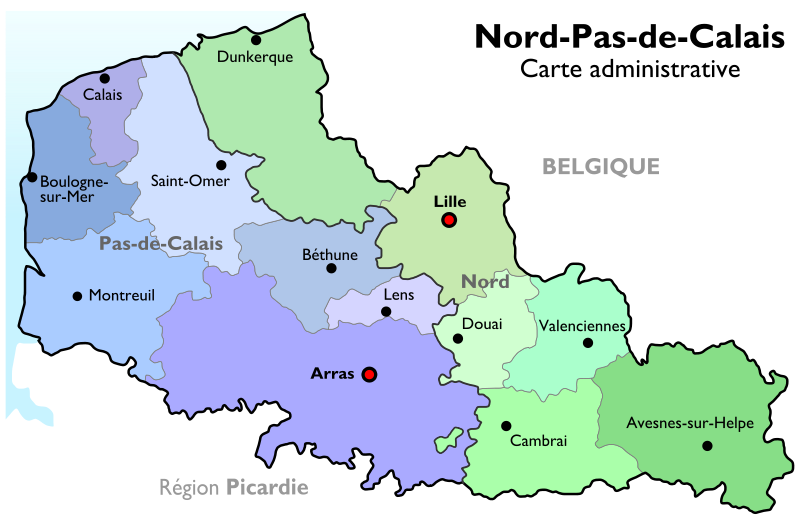
France is divided up into regions, which are divided into departements. I live in the region of Nord-Pas-de-Calais, and in the departement of Nord. The other departement in our region is Pas-de-Calais. Unlike some regions that have creative names, ours is just our two departements hyphenated together.


The purple is the departement of Pas-de-Calais and the green is the departement of Nord.

One of the first words one learns when studying the French language is the word “pas.” It means not.

Je ne suis PAS française = I am NOT French.

I have always thought that the departement “PAS de Calais” was called so because it was NOT from Calais, a coastal town in the department. In my head there was the North, and then there was everything that was NOT considered to be Calais. I also figured that this was a historic naming, as Calais is no longer as important as other cities.

I was wondering what departement Dunkerque was in, and looked it up on google maps. I then made an astonishing discovery that I had to share with FBF.

“FBF, Dunkerque est dans le Nord, mais tu sais ce qu’il y a de bizarre? Calais est juste à côté mais il est DANS le Pas-de-Calais” (FBF, Dunkirk is in the Nord, but do you know what’s weird? Calais is right next to it, but it’s in the Pas-de-Calais).

“Bah oui. C’est normale. C’est le Pas-de-Calais” (Well yeah. That’s normal. It’s the Pas-de-Calais).

"Oui mais si c’est le Pas-de-Calais, il n’est pas sensé d’être pas à Calais?” (Yes, but if it’s the Pas-de-Calais, isn’t it supposed to be NOT Calais?)

This is when I learned that the word pas has two meanings. FBF explained while laughing at me, “Ah, en fait ce n’est pas PAS comme not. C’est pas comme quand on marche” (Ah, actually it’s not pas as in not. It’s pas as in when you walk).

Pas not only means not, but it also means steps or footsteps. So the departement of Pas-de-Calais actually means the steps taken around Calais. Hence why Calais is actually included in the departement’s name.

--------------------------------------------------------------------------------

EDIT: One of my Spanish friends has informed me (and I confirmed with wikipedia) that Pas-de-Calais is translated as the Straight of Dover.

But like my dad says, never let the facts interfere with a good story.

July 27, 2011

Travel Thriftily Tips

Working as an English language assistant in France is great because you are paid to live in France. The not so great aspect of working as an English language assistant in France is that you are paid peanuts. The French government provides you with only enough to live off of - nothing else.

This is fine if all you want to do is teach English and stay put in whatever town you work in, but I wanted to take advantage of my time abroad and travel. So I had to travel cheaply.

When traveling to major, foreign cities I save money two ways. The first way is by taking advantage of New Europe’s free walking tours. The greatest part about these tours is that they are absolutely free. They ask for tips at the end, and you can pay the guide what you will – based on however much money you have left to spend for the day or the merit of the information given on the tour or nothing at all (I’m too nice for option #3).

I went on their three hour walking tours in London and Amsterdam, saw almost all of the sights, and learned amazing facts about buildings I wouldn’t have given a second thought to if I had been wondering the city by myself.

They offer free tours in the following cities:
Amsterdam, Berlin, Brussels, Copenhagen, Dublin, Edinburgh, Jerusalem, Hamburg, London, Madrid, Munich, Paris, Prague, and Tel Aviv.


On my London free tour, I learned that this clock found on the side of the Royal Court of Justice was used in the Harry Potter films for the Hogwarts Express.


On my Amsterdam free tour, I learned that this part of the building had no windows because that's where they used to perform autospies, and it was considered too vulgar to show to the public.


The second way I save money is by always staying in a hostel that has a kitchen. Although they are sometimes more expensive to stay at than their kitchen-free counterparts, you will save tons of money if you use the kitchen facilities instead of having to eat out for every meal.

While I do think tasting the local food is a huge part of traveling, it isn’t necessary to eat out for every meal. Also, in a lot of places it is cheaper to eat out for lunch (Paris, Stockholm) than dinner. You can experience the local gastronomy for cheaper at lunch, then go home and cook yourself some pasta with red sauce for dinner in the hostel kitchen.

In some hostels, they even have a cabinet of “free food,” or food left behind by earlier travelers, in the kitchen. Be sure to browse and see if there isn’t anything worth eating in there before you head to the market. You’d be surprised how often people leave food behind.


Me, enjoying a delicious dinner of pasta, red sauce, and cauliflower in my hostel in Stockholm, plus a random fellow hostel-er, and the kitchen where I cooked said delicious dinner. Also a Swedish beer (On a side note: Swedish beer is like 3% alcohol per volume. Living so close to Belgium I'm used to 8% beers. That beer did nothing for me).


One of the easiest ways to save money while traveling, however, is to explore locally. No need to buy a plane ticket, or find a place to sleep. While Lille is a really wonderful city and ideally located for traveling all around Europe, I have hopped on the commuter trains in order to explore other, smaller cities in the area. Just because it isn’t a nation’s capital or recognizable city name doesn’t mean it has nothing to offer. Get to know the small towns around you and you'll most likely discover hidden gems.


I walked along the beach at Dunkirk and stumbled upon old bunkers used in both WWI & WWII hidden among the sand dunes.


Do you have any advice for traveling cheaply?
Brooke vs. the World has asked travel bloggers to put together their best thrifty and resourceful travel tips for a helpful, free ebook. If you think you’re thrifty and would like to participate, check out the official rules.
Related Posts Plugin for WordPress, Blogger...