For my masters, it is required to take a language class and this semester I decided to enroll in Spanish. Having had 4 years of Spanish in middle school/high school, I figured it’d be easier and serve me better than say Portuguese or Italian.
Learning a third language in one’s second language makes for some pretty interesting brain gymnastics. Nevertheless, I sometimes find that translating things into French makes more sense than the English equivalent (and vise versa).
While hoping there would be a Spanish-English dictionary at France's version of Good Will, Emmaus, there were only Spanish-French ones (but really, at a dollar a dictionary who can complain?). I bought one, confident that I speak French well enough that there shouldn’t be any trouble.
Despite it working out most of the time, looking up I no longer remember what, I stumbled upon the cutest word I have yet to cross in French, pommettes. Not sure what it meant, I asked a classmate.
So, what is a pommette? No, it’s not just a tiny pomme (apple). It’s actually the cheekbone part of your cheeks! The little part that grandmas like to pinch when they tell you they could eat you with a spoon.
I love having a word for that specific part of the cheek. Especially since it seems to fit perfectly. It does resemble a tiny apple one just wants to take a bite out of.
Confession: I'm dating a French boy. Since we met, I always adored his cheeks, but telling him so didn't exactly encompass what I meant. Really, I couldn't get enough of his pommettes. After learning this word, everything just fell into place. It felt right.
Now, my favorite part of Spanish class is enriching my French vocabulary.
Showing posts with label Language. Show all posts
Showing posts with label Language. Show all posts
April 6, 2013

March 2, 2013
Il Fait Beau
I used to disagree with any French person who ever told me “il fait beau” (it's a beautiful day). Especially in winter.
But despite saying, “mais non, il fait froid!” (but it's cold!) occasionally to my exbellemère, I would keep my mouth shut, as they all seemed pretty convinced about the excellence of their days.
It still irked me though. How could the French find so many days “beautiful?” A day needs to be pretty remarkable for it to get that accolade from me.
Maybe it’s because I grew up in Southern California where the weather is some of the best out there, but I seemed to need more from a beautiful day than the French.
I need sunshine and blue skies (although a cloud or two might be acceptable as long as they are the pretty fluffy white kind), a light breeze (but not windy), and a good temperature (hot but not too hot). I want that day to inspire me.

The beach in my hometown. How I miss beautiful, beach-worthy days.
The French seemed to find really ordinary days beautiful.
Then, after three years of hearing this expression, I finally got it. I’d been looking at it all wrong.
One shouldn't translate “il fait beau” into “it’s a beautiful day,” but instead into “the sun is out today.”
It’s as simple as that. To the French, the sun being out is equivalent to beauty. I think this has to do with the fact that the French use the word beautiful 3600 times more often than Americans do.
For a day to be beautiful it doesn’t need to be exceptional; it just needs some sunshine. The word doesn’t carry the same weight.
Once I accepted this fact, my conversations about the weather weren’t secretly putting me on edge.
Now when someone tells me “il fait beau,” I agree. Why yes, the sun is shinning today!
I no longer secretly resent the French for being able to find so many days beautiful. And after having lived in the northern gray climates for three years, I'm starting to understand why the French are so eager to applaud the sun.
But despite saying, “mais non, il fait froid!” (but it's cold!) occasionally to my exbellemère, I would keep my mouth shut, as they all seemed pretty convinced about the excellence of their days.
It still irked me though. How could the French find so many days “beautiful?” A day needs to be pretty remarkable for it to get that accolade from me.
Maybe it’s because I grew up in Southern California where the weather is some of the best out there, but I seemed to need more from a beautiful day than the French.
I need sunshine and blue skies (although a cloud or two might be acceptable as long as they are the pretty fluffy white kind), a light breeze (but not windy), and a good temperature (hot but not too hot). I want that day to inspire me.
The beach in my hometown. How I miss beautiful, beach-worthy days.
The French seemed to find really ordinary days beautiful.
Then, after three years of hearing this expression, I finally got it. I’d been looking at it all wrong.
One shouldn't translate “il fait beau” into “it’s a beautiful day,” but instead into “the sun is out today.”
It’s as simple as that. To the French, the sun being out is equivalent to beauty. I think this has to do with the fact that the French use the word beautiful 3600 times more often than Americans do.
For a day to be beautiful it doesn’t need to be exceptional; it just needs some sunshine. The word doesn’t carry the same weight.
Once I accepted this fact, my conversations about the weather weren’t secretly putting me on edge.
Now when someone tells me “il fait beau,” I agree. Why yes, the sun is shinning today!
I no longer secretly resent the French for being able to find so many days beautiful. And after having lived in the northern gray climates for three years, I'm starting to understand why the French are so eager to applaud the sun.
January 22, 2013
Normalement
Despite being certifiably fluent in French (as was the requirement for my masters program), the first days of school seemed such a language blur. My every day familiar language wasn’t enough.
Technical vocabulary aside, I could tell I’d lost some of my ability over the 8 months spent at home. It has come back to me over time, with hard work and lots of intense listening, leading me to the last week of lectures where I understood everything the teachers said. Well, almost everything.
When giving us details about one of our final exams, the head teacher explained that normalement (normally) we are allowed the use of documents for certain questions posed by different guest lecturers. To me, that left a certain amount of doubt about whether or not things would be the same this year.
After that we didn’t hear whether the test was open book or not, and so I studied everything.
Come test day, it was written on the exam which parts had authorized documents, and which hadn’t. A sense of relief poured over me. This test was going to go better than I had thought.
After the exam, I expressed my sense of joy at being able to use the materials from lecture to my fellow students.
I was the only one relieved, however.
To my French counterparts, the normalement wasn’t so ambiguous.
They expected to be able to use their documents.
May 2, 2012
Taking the DALF (Diplôme approfondi de langue française)
When it started to look 100% like I wasn’t going to get my work visa renewed, I looked into other ways of staying in, or returning to, France. Not yet being ready to make the giant commitment that is matrimony, I decided to attempt to reenter the country in a way that France really likes; for my studies.
In order to do most masters programs in France (for there are a few taught in only English), one needs to have passed either the TEFL or the DELF/DALF at a B2 level. I decided to take the DELF/DALF because it is a life long diploma, whereas the TEFL is a certificate only valid for two years.
Although the programs only required B2, I wanted to push myself and be sure I was taking the highest level I could possibly achieve. After much internal struggle I decided to take the C1. It is possible to take both of them, but the tests do not come cheap and I was unemployed.

The book I bought as my study guide for the DALF.
Free study resources are also available on the CIEP website.
Something I had a lot of trouble coming to terms with is the fact that the French don’t ever think you should get 100% on a test. To pass the DALF one needs to get 50/100 points total, and score at least 5/25 in each section (there are 4 areas). This would be failing a test in America.
I’ve always been an honors student and over achiever. It took me a while, but I finally did accept the fact that there were questions on the test that even FBF wouldn’t be able to answer and it was okay that I didn’t know everything.
The other part of the exam I had to come to terms with is that the first part of the exam (listening comprehension, reading comprehension, and written comprehension) lasts three hours. Three hours during which one is not allowed to leave the room (i.e. no potty breaks).
On the day of the test, stressed out but with an empty bladder, I got to the Alliance Française office ten minutes early. I met my fellow testees, two middle-aged people taking the test purely for pleasure. I couldn’t believe anybody would torture themselves in this way.
The test started. The listening comprehension boosted my confidence; I understood almost everything that came out of the speakers. The reading comprehension part proved more difficult, but that was to be expected. Overall I came out of the listening/reading/essay writing part of the exam feeling pretty good.
Then I had a two-hour break to eat lunch and become even more stressed out for the oral presentation part of the exam (which lasts 1.5 hours; one hour to prepare and 30 minutes of presenting).
Although I felt most confident about my speaking skills (thanks to FBF and speaking French every day for the past two years), speaking in front of people who are grading you is so much more difficult than simply talking to your boyfriend. Nevertheless, after making a joke about being really nervous, I was able to present almost everything I prepared, and even stayed after to chat with the graders (in French, of course).
Although I felt as if I had passed, I didn't want to simply pass. I wanted to excel. I also was worried that I might have misunderstood everything and would never be allowed to go to graduate school in France. My whole future plan was dependent upon passing this test.
For the first time in my dealings with France, however, the turn around time for finding out if you pass is super quick.
After a week I called the Alliance Française to ask if I passed. After getting my name, the lady on the phone said, “oh! You scored very high! You passed with 70/100!”

My score.
Relief and pride washed over me all at once. Not only did I pass and would be eligible for graduate school in France, but I scored very high. Ladies and gentlemen, I am officially, government recogonized-ly, fluent in French.
In order to do most masters programs in France (for there are a few taught in only English), one needs to have passed either the TEFL or the DELF/DALF at a B2 level. I decided to take the DELF/DALF because it is a life long diploma, whereas the TEFL is a certificate only valid for two years.
Although the programs only required B2, I wanted to push myself and be sure I was taking the highest level I could possibly achieve. After much internal struggle I decided to take the C1. It is possible to take both of them, but the tests do not come cheap and I was unemployed.
The book I bought as my study guide for the DALF.
Free study resources are also available on the CIEP website.
Something I had a lot of trouble coming to terms with is the fact that the French don’t ever think you should get 100% on a test. To pass the DALF one needs to get 50/100 points total, and score at least 5/25 in each section (there are 4 areas). This would be failing a test in America.
I’ve always been an honors student and over achiever. It took me a while, but I finally did accept the fact that there were questions on the test that even FBF wouldn’t be able to answer and it was okay that I didn’t know everything.
The other part of the exam I had to come to terms with is that the first part of the exam (listening comprehension, reading comprehension, and written comprehension) lasts three hours. Three hours during which one is not allowed to leave the room (i.e. no potty breaks).
On the day of the test, stressed out but with an empty bladder, I got to the Alliance Française office ten minutes early. I met my fellow testees, two middle-aged people taking the test purely for pleasure. I couldn’t believe anybody would torture themselves in this way.
The test started. The listening comprehension boosted my confidence; I understood almost everything that came out of the speakers. The reading comprehension part proved more difficult, but that was to be expected. Overall I came out of the listening/reading/essay writing part of the exam feeling pretty good.
Then I had a two-hour break to eat lunch and become even more stressed out for the oral presentation part of the exam (which lasts 1.5 hours; one hour to prepare and 30 minutes of presenting).
Although I felt most confident about my speaking skills (thanks to FBF and speaking French every day for the past two years), speaking in front of people who are grading you is so much more difficult than simply talking to your boyfriend. Nevertheless, after making a joke about being really nervous, I was able to present almost everything I prepared, and even stayed after to chat with the graders (in French, of course).
Although I felt as if I had passed, I didn't want to simply pass. I wanted to excel. I also was worried that I might have misunderstood everything and would never be allowed to go to graduate school in France. My whole future plan was dependent upon passing this test.
For the first time in my dealings with France, however, the turn around time for finding out if you pass is super quick.
After a week I called the Alliance Française to ask if I passed. After getting my name, the lady on the phone said, “oh! You scored very high! You passed with 70/100!”
My score.
Relief and pride washed over me all at once. Not only did I pass and would be eligible for graduate school in France, but I scored very high. Ladies and gentlemen, I am officially, government recogonized-ly, fluent in French.
March 23, 2012
Comment Dit-on?
One of my family's stories is about my Uncle Gene. Gene studied abroad while he was in college, spending a semester living in Vienna, Austria. When he came back from being abroad, my mother says, he used to flaunt it in everyone’s faces, continually asking, “oh wait… how do you say [insert German word] in English again?”
I would always laugh at how pompous Uncle Gene had been, sure of the fact that he was just being snobby and shoving his German knowledge under everyone’s noses.
Ladies and Gentlemen, I have become Uncle Gene.
Since moving home, I am often times unable to think up a word in English. My sentences no longer flow. I find myself starting a sentence in a way that only makes sense in French.
I’ve been home for quite a while now, and yet I continue to find myself in situations where my brain is unable to come up with an American equivalent of what I want to say.
Sure, when I came home after a semester of studying abroad in Paris I didn’t have this problem, but when I compare my study abroad experience to my uncle’s (I got to Skype home every weekend and spoke English at school; he never got to call home and was immersed in a German university), I say he really did earn the right to forget English words.
And while I still do feel ridiculous and pretentious every time I forget a word in my native language, I know I’m not doing it on purpose or to show off.
It’s made me “rethink” my opinion of my uncle.
Have you moved back home after a long period abroad? How long did it take you to feel like your English was back to Native-Speaker-Normality? It's been 4 months already, brain, get it together!
March 9, 2012
Après
In school we’re taught that après means after. After as in subsequent to, for example “after we eat diner, we do the dishes,” and not as in to resemble, for example “he takes after his father.” While that second one is a phrasal verb, when I thesaurus-ed “after” it came up with both.
The French don’t seem to have such a rigid view of the word après, and it took me quite a while to get used to it.
When we first started dating, FBF would often ask me if I wanted to do something après.
To which I would reply, “after… What?”
He would reply with things like, “oh, after we finish eating” or “after the game is over” and would put it into a more concrete context.
But once we were finished with the designated activity, we wouldn’t always do what was supposed to happen après immediately after.
After much frustration and confusion, one day it dawned on me. I had to stop thinking about after quite so literally.
Après when used like this is actually similar to the dreaded American usage of “later.” Later as in some unidentified time in the future, for example "I'll call you later."
Later holds all the annoying flexibility that the French put into the word après.
I wonder if the use of après when said by one's crush in relation to an activity the two of you are going to do together sends French girls into a fit of over-analysis just as "later" did to 14 year old me.
January 27, 2012
Le Boudoir
FBF has always gotten a kick out of the things Americans consider French that aren’t French at all. While the French do say “sacre,” they never add the “bleu.” They don’t say ménage-à-trois when speaking about threesomes (a plan-à-trois or a partouse).
The first time I said the word “boudoir,” he didn’t understand what I was talking about. I had assumed he’d know what I was talking about because I had assumed boudoir was a French word. FBF immediately laughed at me. Boudoir, he assured me between chuckles, is not a French word.
The closest thing is bouder; a French verb meaning to pout.
After explaining to him that it means bedroom (and often said in a way that implies all of the things one might do in said bedroom... or maybe that's just me?), he combined the two definitions to create a new one : “une chambre où on vas pour bouder” (a room where we go to pout).
We continued to use the word in that sense for a while, until one fateful day at the beach in Brittany last summer.
Being in Brittany meant I met a whole new slew of FBF’s childhood friends and once again was bombarded by questions about America.
One of his friends is getting her masters in French literature from La Sorbonne. We got to talking about the use of fake French words in English, and I brought up boudoir.
Much to my delight, and FBF’s humiliation, boudoir is in fact a French word! It's a small room originally created for women to have an intimate, private space amongst themselves, similar to a powder room in English (in the “ladies, don’t we all have to powder our noses at the same time?” sense).

An illustration of a boudoir.
In fairness to FBF, it is a dated term originating from the verb bouder, so he was half right. Plus he's a chemist. I doubt he's ever studied the French language dating from the Era of the Sun King in much length.
As this is not the first time he's lead me astray when it comes to translations (like what the pas means in Nord-Pas-de-Calais), I am as much to blame as he is. I really ought to learn my lesson and stop trusting him on matters of his own language.
Do you know of any "French" words we use in English that aren't French at all? Does your French boyfriend continually lead you astray in matters of the French language?
The first time I said the word “boudoir,” he didn’t understand what I was talking about. I had assumed he’d know what I was talking about because I had assumed boudoir was a French word. FBF immediately laughed at me. Boudoir, he assured me between chuckles, is not a French word.
The closest thing is bouder; a French verb meaning to pout.
After explaining to him that it means bedroom (and often said in a way that implies all of the things one might do in said bedroom... or maybe that's just me?), he combined the two definitions to create a new one : “une chambre où on vas pour bouder” (a room where we go to pout).
We continued to use the word in that sense for a while, until one fateful day at the beach in Brittany last summer.
Being in Brittany meant I met a whole new slew of FBF’s childhood friends and once again was bombarded by questions about America.
One of his friends is getting her masters in French literature from La Sorbonne. We got to talking about the use of fake French words in English, and I brought up boudoir.
Much to my delight, and FBF’s humiliation, boudoir is in fact a French word! It's a small room originally created for women to have an intimate, private space amongst themselves, similar to a powder room in English (in the “ladies, don’t we all have to powder our noses at the same time?” sense).
An illustration of a boudoir.
In fairness to FBF, it is a dated term originating from the verb bouder, so he was half right. Plus he's a chemist. I doubt he's ever studied the French language dating from the Era of the Sun King in much length.
As this is not the first time he's lead me astray when it comes to translations (like what the pas means in Nord-Pas-de-Calais), I am as much to blame as he is. I really ought to learn my lesson and stop trusting him on matters of his own language.
Do you know of any "French" words we use in English that aren't French at all? Does your French boyfriend continually lead you astray in matters of the French language?
November 18, 2011
"..." ou «...»
I had been hearing, and using, the expression “entre gemey” without ever seeing it written or knowing what it literally meant. To me, people used it when expressing doubt, similar to how Americans use supposedly. Since I wasn’t 100% confident about its meaning, I didn’t use it all the time, but I did feel like I understood it enough to not have to ask what it meant when used in context.
This summer a revelation happened between me and this phrase.
La Soeur’s step kids (11 & 9) were camping with us, and were being forced to do dictées. A dictée is when the students are read a small paragraph, and are expected to copy it down without any spelling or grammatical errors.
FBF wanted to be the one to read to them in order to gloat about no longer being in elementary school and having his dictée-days behind him. He read the paper out loud and I followed along. It soon became apparent that FBF was not a very good dictée reader, as he would forget to tell them when a sentence was finished, or what type of punctuation to write. After being scolded a couple of times by the 9 year old, he finally got it together. On the third reading, he was telling them all the punctuation a person could need; point (period), virgule (comma), point d’interogation (question mark), etc.
Part of the dictée was a quotation, and I was eager to learn what this particular punctuation is called in French. FBF said it, and suddenly a light bulb went off in my head.
Ladies and Gentlemen, quotation marks are called “gemeys,” spelled guillemets, in French.
“Comme entre guillemets!” I exclaimed, barely able to contain my excitement of figuring out another piece of the puzzle which is the French language.
I’ve now added a very American action to when I say entre guillemets. I make quotation mark signs with my pointer and middle finger, regardless of the fact that while American quotation marks look like this “ “, French ones look like this « ». Maybe I should be turning my hands sideways instead?

What should be France's version of air quotes.
This summer a revelation happened between me and this phrase.
La Soeur’s step kids (11 & 9) were camping with us, and were being forced to do dictées. A dictée is when the students are read a small paragraph, and are expected to copy it down without any spelling or grammatical errors.
FBF wanted to be the one to read to them in order to gloat about no longer being in elementary school and having his dictée-days behind him. He read the paper out loud and I followed along. It soon became apparent that FBF was not a very good dictée reader, as he would forget to tell them when a sentence was finished, or what type of punctuation to write. After being scolded a couple of times by the 9 year old, he finally got it together. On the third reading, he was telling them all the punctuation a person could need; point (period), virgule (comma), point d’interogation (question mark), etc.
Part of the dictée was a quotation, and I was eager to learn what this particular punctuation is called in French. FBF said it, and suddenly a light bulb went off in my head.
Ladies and Gentlemen, quotation marks are called “gemeys,” spelled guillemets, in French.
“Comme entre guillemets!” I exclaimed, barely able to contain my excitement of figuring out another piece of the puzzle which is the French language.
I’ve now added a very American action to when I say entre guillemets. I make quotation mark signs with my pointer and middle finger, regardless of the fact that while American quotation marks look like this “ “, French ones look like this « ». Maybe I should be turning my hands sideways instead?
What should be France's version of air quotes.
November 4, 2011
Directions
When I studied abroad in Paris back in 2007 it was the highlight of my trip, the proof beyond all else that I had managed to fool everybody and seem French, when somebody would ask me for directions. This happened a total of three times and I was elated after each instance.
Even if I never knew the way, I still felt in. I was being confused for a Parisienne. All my hard work had paid off. It didn’t matter that I hadn’t memorized everything in city in 4 months. I was being asked for directions.
Living in the heart of Lille and walking everywhere these past two years means that I know my way around town even better than FBF (in all fairness, he does live in the suburbs).
So when an elderly lady stopped me in the middle of the street to ask me for directions, I was feeling pretty confident. She asked me if I knew how to get to Aux Merveilleux, a pastry shop famous for it’s own creation called a merveilleux.
And as luck would have it, I did know where it was. I could have easily walked there from where she had stopped me. Feeling very French, I started to respond, only to realize that despite being able to get there myself, I was not going to be any help to a lost stranger. I do not know any street names.
In the panic of not being able to be any help whatsoever, I answered her, “hien… bon tu vas par là, et je suis desolée mais je ne connais pas les noms des rues, alors…. Tu continues par cette rue là et puis… en fait, est-ce que tu connais la rue de la monnaie?” (Umm.. well you take this road, and I’m sorry but I don’t know street names, so….. you continue down this street and then.. actually do you know rue de la monnaie?)
While she answered that she did in fact know where rue de la monnaie is, I realized a second huge mistake I had made when talking to a stranger, especially one who is older than me. I had been tu-ing her.
I corrected my mistake and vous-ed her for the rest of our short interaction, saying simply, “Alors vous vont aller jusqu’au rue de la monnai et puis vous prendrez à gauche. Après un moment, vous allez y arriver” (So go until you hit rue de la monnai and then turn left. After walking a bit you’ll get there).
She thanked me and went on her merry way.
Before when I got asked for directions I was on cloud nine, even if all I could mumble back in reply was “Je ne sais pas… desolée” with a very American accent.
This time getting asked for directions crushed my sense of Frenchness. After being here for two years I still couldn’t tell somebody how to get somewhere? And even worse, I didn’t remember to use vous?
I continued my day disappointed in my abilities. But my embarrassment served a greater purpose.
A few weeks later a woman who looked to be in her thirties stopped me on the street to ask me for directions to an Indian restaurant. To my surprise, not only did I know how to get there, but it was close enough to describe it without using street names. After remembering my mistake with the old lady, I made sure to use vous.
She thanked me while starting to follow my directions, and I continued on my original path feeling ever so Lilloise this time around.
September 9, 2011
Les Couleurs
When I first learned the colors of the rainbow, they were as follows: Red, Orange, Yellow, Green, Blue, and Purple. Then, in 2nd grade, my mind was blown away by the revelation that Purple was actually two colors, Indigo and Violet.
My color repertoire expanded greatly in 5th grade when I started using the computer. I would choose bright colors with new names, such as Magenta and Cyan.
And while now as a fully-grown adult I am aware that there are a gazillion names for a gazillion different colors (thank you paint companies), I still mainly use the original 6 to describe the world around me, with a few adjectives (dark, light, neon, etc) thrown in here and there.
It came to my attention one day while rushing around my apartment, that the French have more than 6 main colors to describe their immediate surroundings.
“Je n’arrive pas à trouver mon saaaaaaac!” (I can’t find my baaaag!) I announced to FBF.
“C’est lequel?” (Which bag is it?) FBF asked, starting to look around himself.
Now compared to what I had in les états-unis, my purse collection here is tiny. I have 7. They are all different colors.
Thinking the color would be the fastest and easiest way to distinguish this particular bag from its counterparts, I said, “C’est le rouge” (It’s the red one).
This, apparently, was no help to FBF. “Hein? Tu as un sac rouge?” (Huh? You have a red bag?).
Seconds later, I had laid my hands upon said bag. “You know! This one! My red Longchamp bag,” I said while shoving it in his face.
“Oh!” He exclaimed. “That’s not red! It’s Bordeaux.”

Myred bordeaux colored bag.
My color repertoire expanded greatly in 5th grade when I started using the computer. I would choose bright colors with new names, such as Magenta and Cyan.
And while now as a fully-grown adult I am aware that there are a gazillion names for a gazillion different colors (thank you paint companies), I still mainly use the original 6 to describe the world around me, with a few adjectives (dark, light, neon, etc) thrown in here and there.
It came to my attention one day while rushing around my apartment, that the French have more than 6 main colors to describe their immediate surroundings.
“Je n’arrive pas à trouver mon saaaaaaac!” (I can’t find my baaaag!) I announced to FBF.
“C’est lequel?” (Which bag is it?) FBF asked, starting to look around himself.
Now compared to what I had in les états-unis, my purse collection here is tiny. I have 7. They are all different colors.
Thinking the color would be the fastest and easiest way to distinguish this particular bag from its counterparts, I said, “C’est le rouge” (It’s the red one).
This, apparently, was no help to FBF. “Hein? Tu as un sac rouge?” (Huh? You have a red bag?).
Seconds later, I had laid my hands upon said bag. “You know! This one! My red Longchamp bag,” I said while shoving it in his face.
“Oh!” He exclaimed. “That’s not red! It’s Bordeaux.”
My
August 1, 2011
Pas-de-Calais
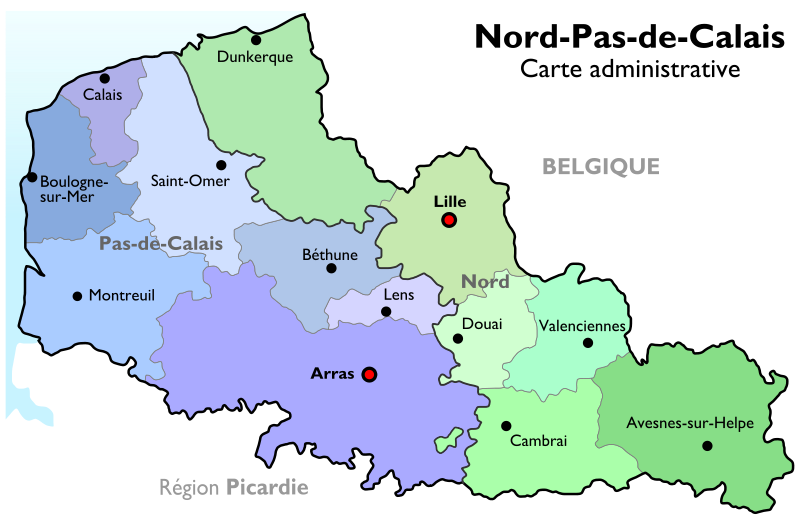
France is divided up into regions, which are divided into departements. I live in the region of Nord-Pas-de-Calais, and in the departement of Nord. The other departement in our region is Pas-de-Calais. Unlike some regions that have creative names, ours is just our two departements hyphenated together.

The purple is the departement of Pas-de-Calais and the green is the departement of Nord.
One of the first words one learns when studying the French language is the word “pas.” It means not.
Je ne suis PAS française = I am NOT French.
I have always thought that the departement “PAS de Calais” was called so because it was NOT from Calais, a coastal town in the department. In my head there was the North, and then there was everything that was NOT considered to be Calais. I also figured that this was a historic naming, as Calais is no longer as important as other cities.
I was wondering what departement Dunkerque was in, and looked it up on google maps. I then made an astonishing discovery that I had to share with FBF.
“FBF, Dunkerque est dans le Nord, mais tu sais ce qu’il y a de bizarre? Calais est juste à côté mais il est DANS le Pas-de-Calais” (FBF, Dunkirk is in the Nord, but do you know what’s weird? Calais is right next to it, but it’s in the Pas-de-Calais).
“Bah oui. C’est normale. C’est le Pas-de-Calais” (Well yeah. That’s normal. It’s the Pas-de-Calais).
"Oui mais si c’est le Pas-de-Calais, il n’est pas sensé d’être pas à Calais?” (Yes, but if it’s the Pas-de-Calais, isn’t it supposed to be NOT Calais?)
This is when I learned that the word pas has two meanings. FBF explained while laughing at me, “Ah, en fait ce n’est pas PAS comme not. C’est pas comme quand on marche” (Ah, actually it’s not pas as in not. It’s pas as in when you walk).
Pas not only means not, but it also means steps or footsteps. So the departement of Pas-de-Calais actually means the steps taken around Calais. Hence why Calais is actually included in the departement’s name.
--------------------------------------------------------------------------------
EDIT: One of my Spanish friends has informed me (and I confirmed with wikipedia) that Pas-de-Calais is translated as the Straight of Dover.
But like my dad says, never let the facts interfere with a good story.
July 21, 2011
3 Tricks for Speaking Better French
When I first studied abroad in Paris, they had all of us write down a list of goals of what we wanted to see or do during our 4-month sejour in France. Despite having only taken one quarter of French beforehand, I wrote “become fluent in French” on my list.
Unfortunately for my naive study abroad self, I was nowhere near fluent at the end of my 4-month stay.
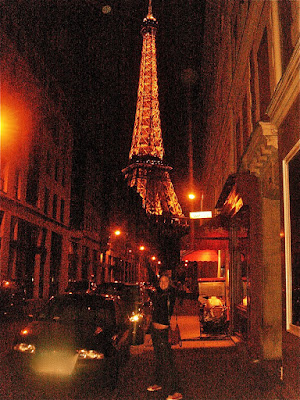
The study abroad Laura. The first and only picture of me from those entire 4 months with the Eiffel Tower in the background.
Clearly I should have written "take a better Eiffel Tower picture" on my list.
I made it pretend to be sepia otherwise you couldn't see me.
Even today I hesitate to call myself fluent, as it is such an all-encompassing word. Nevertheless, FBF insists that I am, and even I must admit that I have progressed tenfold since I first moved here back in 2009.
Going from not-understanding-FBF-talking-to-me when we first met to speaking-French-without-realizing-I-was when FBF drove me home the other day has taken a lot of practice. I've also picked up a few handy dandy tricks along the way.
Here are 3 tricks for speaking better French:
1. Fake it till you make it
A lot of the time when I don’t know the French equivalent for what I want to say, I say the word in English with a French accent. You’d be surprised how often this works.
I used this just last weekend. I was talking about things becoming decriminalized, but had no idea how to say that in French. So I just said “decriminalisé.” It worked.
2. Context clues
Especially while reading, but also during conversation, it is not important to understand every single word precisely. Don’t get hung up on one word! Listen to the rest of the conversation/read the rest of the sentence, and more often than not you’ll be able to deduce what the previously unknown word means.
If you look at the first sentence of this post, I left a French word undefined. But based on the rest of the sentence, I'm betting you figured it out. You might not be sure if it means trip, or stay, or sojourn, or study abroad experience, but you get the general idea. A lot of the time, the general idea is more than enough.
(P.S. Sorry if rule #2 feels like the SATs. The good news is it doesn't matter which answer is the "best answer," as long as you are able to communicate!)
3. Actual Friends
People are constantly warning us non-native French speakers to be aware of “faux-amis,” or false friends, which are words that sound same in both French and English, but have very different meanings. While there are a few (like mail), I’ve come to realize that most of the time words that sound similar tend to have similar meanings!
For example, the French word for Christian is chrétien. Although they are written very differently, to me they sound similar. The French one is pronounced "Kre" + "Tea-un," which to me sounds like "Christian" without the s (but with a French accent, biensûr).
This is why rule #1 works, and if you combine this with rule #2, you might even be able to discern the slight differences in meaning between the French and English words that actually do hang out together.
Unfortunately for my naive study abroad self, I was nowhere near fluent at the end of my 4-month stay.

The study abroad Laura. The first and only picture of me from those entire 4 months with the Eiffel Tower in the background.
Clearly I should have written "take a better Eiffel Tower picture" on my list.
I made it pretend to be sepia otherwise you couldn't see me.
Even today I hesitate to call myself fluent, as it is such an all-encompassing word. Nevertheless, FBF insists that I am, and even I must admit that I have progressed tenfold since I first moved here back in 2009.
Going from not-understanding-FBF-talking-to-me when we first met to speaking-French-without-realizing-I-was when FBF drove me home the other day has taken a lot of practice. I've also picked up a few handy dandy tricks along the way.
Here are 3 tricks for speaking better French:
1. Fake it till you make it
A lot of the time when I don’t know the French equivalent for what I want to say, I say the word in English with a French accent. You’d be surprised how often this works.
I used this just last weekend. I was talking about things becoming decriminalized, but had no idea how to say that in French. So I just said “decriminalisé.” It worked.
2. Context clues
Especially while reading, but also during conversation, it is not important to understand every single word precisely. Don’t get hung up on one word! Listen to the rest of the conversation/read the rest of the sentence, and more often than not you’ll be able to deduce what the previously unknown word means.
If you look at the first sentence of this post, I left a French word undefined. But based on the rest of the sentence, I'm betting you figured it out. You might not be sure if it means trip, or stay, or sojourn, or study abroad experience, but you get the general idea. A lot of the time, the general idea is more than enough.
(P.S. Sorry if rule #2 feels like the SATs. The good news is it doesn't matter which answer is the "best answer," as long as you are able to communicate!)
3. Actual Friends
People are constantly warning us non-native French speakers to be aware of “faux-amis,” or false friends, which are words that sound same in both French and English, but have very different meanings. While there are a few (like mail), I’ve come to realize that most of the time words that sound similar tend to have similar meanings!
For example, the French word for Christian is chrétien. Although they are written very differently, to me they sound similar. The French one is pronounced "Kre" + "Tea-un," which to me sounds like "Christian" without the s (but with a French accent, biensûr).
This is why rule #1 works, and if you combine this with rule #2, you might even be able to discern the slight differences in meaning between the French and English words that actually do hang out together.
July 19, 2011
Omar M’a Tuer
I took advantage of La Fête du Cinéma in order to practice my French oral comprehension. Seeing as movie tickets were only 3euros, I picked the only French movie that was out that didn’t look like a really bad comedy.
Besides the description provided by UGC lille,
I knew nothing about the Omar Raddad Affair, which was a very big deal in the 90s in France.
Long story short, a rich French woman was found murdered, locked in her pitch black basement. On the walls “Omar M’a Tuer” and “Omar M’a T" were written in her blood.
The police believed she had written this on the walls herself with her dying strength (in the absolute dark without making any mistakes..) and so they went to arrest Omar Raddad, her gardener, who is Moroccan. Despite the only evidence to implicate him being what is written on the walls, he is found guilty and is sentenced to 18 years in prison.
Three years later, Jacques Verges, a French writer, believing Omar to be innocent decides to investigate the crime himself. He then writes a book entitled Omar M’a Tuer: Histoire d’un crime. In his book, he basically shows how the judicial system screwed over Omar and brings to light new suspects.
In the end, then President Jacques Chirac reduces Omar’s sentence. In 1998, he is let out of jail after six and a half years spent in prison for a crime he didn’t commit. In 2001 they did DNA testing, and although they found two distinct sets of male DNA at the scene of the crime, Omar was not a match.
[Disclaimer: Although my French is pretty good, there were definitely some scenes I did not understand. If I got anything wrong do not hesitate to correct me, thanks!]
The Movie Trailer. It was a good movie and I recommend seeing it!
This movie made me terrified of the French judicial system.
I know America has probably sent its fair share of innocent people to jail for crimes they didn’t commit, but Omar was treated thusly for one simple reason: He is not French. He is Moroccan. He is a foreigner.
I think the hardest scene for me to watch was when they interrogate him after arresting him.
Despite saying several times that he does not speak French, they continue to yell at and harass him in French, accusing him of murdering his boss. After having photos of the murder shoved under his nose, he starts to understand what’s going on, but is unable to express himself in French.
Sometimes I forget my French words when I’m nervous because I’m meeting someone new. I can’t imagine how stressful it would be to try and communicate in French while the police are yelling at me in super speedy French while shoving pictures of murdered people under my nose. Plus, based on the movie's portrayal of him, I speak way better French than Omar.
It made me cringe to watch him treated that way. I spent most of the film cringing, actually.
The law has since changed. Now it is required that anyone being detained by the police get read their rights in a language they understand.
One thing that I find very interesting is that my French friends do not understand my fear. They all make the joke that since I’m not Arabic, I wont have these same types of problems.
While I realize there is a lot of racism towards Arabic people in France, there is also racism towards foreigners in general. A fellow American expat blogger living in Lille, Traveling Amber, has been dealing with racism towards American foreigners for a while now.
I am realistic and know that it is unlikely that I will be framed for murder, and put in jail with little to no evidence against me, but this film really opened my eyes to the differences between how I could expect to be treated by the American justice system as an American citizen, and how I could expect to be treated in France as a foreigner.
On the bright side, the movie was really well done; intriguing, thought provoking, and full of great characters. It was definitely worth those 3euros.
What do you think about the Omar Raddad Affair? Do you find it shocking at all? Is the French judicial system something to be afraid of? I'd love to hear how you feel about it.
Besides the description provided by UGC lille,
“1991. Omar Raddad est emprisonné pour le meurtre de Madame Marchal qui l'employait comme jardinier. Trois ans plus tard, un écrivain convaincu de son innocence décide de mener sa propre enquête. Les destins croisés de deux hommes que tout oppose."
I knew nothing about the Omar Raddad Affair, which was a very big deal in the 90s in France.
Long story short, a rich French woman was found murdered, locked in her pitch black basement. On the walls “Omar M’a Tuer” and “Omar M’a T" were written in her blood.
The police believed she had written this on the walls herself with her dying strength (in the absolute dark without making any mistakes..) and so they went to arrest Omar Raddad, her gardener, who is Moroccan. Despite the only evidence to implicate him being what is written on the walls, he is found guilty and is sentenced to 18 years in prison.
Three years later, Jacques Verges, a French writer, believing Omar to be innocent decides to investigate the crime himself. He then writes a book entitled Omar M’a Tuer: Histoire d’un crime. In his book, he basically shows how the judicial system screwed over Omar and brings to light new suspects.
In the end, then President Jacques Chirac reduces Omar’s sentence. In 1998, he is let out of jail after six and a half years spent in prison for a crime he didn’t commit. In 2001 they did DNA testing, and although they found two distinct sets of male DNA at the scene of the crime, Omar was not a match.
The Movie Trailer. It was a good movie and I recommend seeing it!
This movie made me terrified of the French judicial system.
I know America has probably sent its fair share of innocent people to jail for crimes they didn’t commit, but Omar was treated thusly for one simple reason: He is not French. He is Moroccan. He is a foreigner.
I think the hardest scene for me to watch was when they interrogate him after arresting him.
Despite saying several times that he does not speak French, they continue to yell at and harass him in French, accusing him of murdering his boss. After having photos of the murder shoved under his nose, he starts to understand what’s going on, but is unable to express himself in French.
Sometimes I forget my French words when I’m nervous because I’m meeting someone new. I can’t imagine how stressful it would be to try and communicate in French while the police are yelling at me in super speedy French while shoving pictures of murdered people under my nose. Plus, based on the movie's portrayal of him, I speak way better French than Omar.
It made me cringe to watch him treated that way. I spent most of the film cringing, actually.
The law has since changed. Now it is required that anyone being detained by the police get read their rights in a language they understand.
One thing that I find very interesting is that my French friends do not understand my fear. They all make the joke that since I’m not Arabic, I wont have these same types of problems.
While I realize there is a lot of racism towards Arabic people in France, there is also racism towards foreigners in general. A fellow American expat blogger living in Lille, Traveling Amber, has been dealing with racism towards American foreigners for a while now.
I am realistic and know that it is unlikely that I will be framed for murder, and put in jail with little to no evidence against me, but this film really opened my eyes to the differences between how I could expect to be treated by the American justice system as an American citizen, and how I could expect to be treated in France as a foreigner.
On the bright side, the movie was really well done; intriguing, thought provoking, and full of great characters. It was definitely worth those 3euros.
What do you think about the Omar Raddad Affair? Do you find it shocking at all? Is the French judicial system something to be afraid of? I'd love to hear how you feel about it.
June 29, 2011
Chier – Not Always To Poop
Often times when growing up in America, one is told to not have a potty mouth. We are discouraged from talking about all manner of bodily functions.
In France, there is no such thing as a potty mouth, and if there were, every French person would have one.
They take toilet related talk to the next level by using it nonchalantly in everyday speech.
Instead of saying, “this person or this object annoys me, ”
(Which could be said in accurate French as follows:
Cette personne ou cet objet m’embête)
They say, “ça me fait chier!”
Which literally translates into, “it makes me poop!”
Can you imagine saying this in English? “Jeez, I really can’t deal with so-and-so today. She makes me poop.”
And this isn’t the only situation where poop comes into play.
And if you'd like to be a little stronger in your word choice, just add France's favorite: putain.
"Putain, fait chier! J'ai oublié mes clés de voiture."
In France, there is no such thing as a potty mouth, and if there were, every French person would have one.
They take toilet related talk to the next level by using it nonchalantly in everyday speech.
Instead of saying, “this person or this object annoys me, ”
(Which could be said in accurate French as follows:
Cette personne ou cet objet m’embête)
They say, “ça me fait chier!”
Which literally translates into, “it makes me poop!”
Can you imagine saying this in English? “Jeez, I really can’t deal with so-and-so today. She makes me poop.”
And this isn’t the only situation where poop comes into play.
- Instead of saying, “I am so frustrated by this situation/object,”
(Je suis frustré à cause de celle-ci, celle-là OR Celle-ci, celle-là m’ennerve)
They say, “ça me fait chier!”
“I can’t get the computer to work! It makes me poop!” - Instead of saying, “that really sucks/that’s a disappointment/that’s a bummer/etc,”
(Quel dommage!)
They say, “oh, ça fait chier…”
Which, as it's missing the me becomes a more general sentiment,
"Oh, it makes poop that you got a parking ticket." - Instead of saying, “this person is annoying,”
(il/elle est embêtant/e)
They say, “il/elle est chiant/e.”
Which could translate to, “he/she makes me want to poop.”
"God, Sandra makes me want to poop. She's always talking with her mouth full." - Instead of saying, “darn/drat!”
(zut OR mince!)
They say, “fait chier!”
Which is slightly different from ça me fait chier, and translates better as “make poop!”
"Oh, make poop! I forgot my car keys."
And if you'd like to be a little stronger in your word choice, just add France's favorite: putain.
"Putain, fait chier! J'ai oublié mes clés de voiture."
June 24, 2011
La Belle Ville de Bergues
FBF and I took a surprisingly long drive over to Bergues (it’s about an hour from Lille) in order to explore the town that has become famous due to Dany Boon’s hit movie about Le Nord, Bienvenue Chez Les Ch’tis.
(trailer with English subtitles).
I wanted to see the places where they filmed the movie, drink me some Ch’ti beer, and eat at the baraque à frites (French fry stand – specifically Friterie Momo from the film). But what we discovered was much more than just a film set.
We got there around lunchtime and hit up the Office du Tourisme. They have a Bienvenue Chez Les Ch’tis tour in the afternoons at 15h and 15h30 that costs only 4euros!

Free map and my ticket to the Ch'tis tour.
After being thoroughly excited about the fact that there is an actual tour that takes you to all the places they filmed the movie, we decided to have lunch while waiting for the ticket office to open. As with almost all public services in France, the Office du Tourisme was closed for lunch, and wouldn’t be opening again until 14h (because everybody needs a 2 hour lunch break, amIright?).
This is when we experienced my first and only disappointment with Bergues. Not only is Chez Momo not permanently in Bergues, there wasn’t a single baraque à frites in sight.
Dismayed, but determined, we ate at the French fry stand that was in a building instead of a caravan, and I proceeded to have the best French fries of my life.
They were the perfect amount of a crispy exterior yet fondant interior. I ate all of mine, and some of FBF’s.
To compliment those lovely frites we chose none other than Ch’ti beer.

My lunch of beer and fries. I might have had two ch'ti blonde beers instead of just one...
Having an hour to kill after eating, we decided to wonder aimlessly around the city.
We discovered the remains of an ancient monastery from the 1100s that was mostly destroyed during the French Revolution.

Really old monastery, complete with gardens.
We also learned that Bergues is a walled in city, and still has all its ramparts.

The ramparts made it seem like a fairy tale city.
Before getting to walk around all the ramparts, however, it was time to go on the Bienvenue Chez Les Ch’tis 1.5 hour walking tour. It was definitely worth the 4 euros. The woman who took us on the tour was very knowledgeable, shared fun facts about the shooting, and had a binder full of pictures of the movie making process.
Here are a few photos of the various places we saw:

The real Bergues Post Office. Dany Boon was unable to get permission from the French government to use the real building, so they used La Poste's logo on another building, creating their own post office.

The post office from the movie (there was a truck blocking it so I couldn't get a straight on view).

The bridge where Dany Boon and Kad Merad relieved themselves during the film!

The top of la beffroi (belltower) where Dany Boon's character is the carillonneur (person who plays the bells).

The bottom of la beffroi, as well as the office du tourisme.
Dany Boon wanted to create a movie about his region and challenge some preconceived notions about life up here in le ch’nord. This is why the film does not show case Bergue’s monastery, ramparts, or old churches, and instead focuses on things common throughout the region, such as the beffroi, or the nonexistent baraque à frites.
(trailer with English subtitles).
I wanted to see the places where they filmed the movie, drink me some Ch’ti beer, and eat at the baraque à frites (French fry stand – specifically Friterie Momo from the film). But what we discovered was much more than just a film set.
We got there around lunchtime and hit up the Office du Tourisme. They have a Bienvenue Chez Les Ch’tis tour in the afternoons at 15h and 15h30 that costs only 4euros!
Free map and my ticket to the Ch'tis tour.
After being thoroughly excited about the fact that there is an actual tour that takes you to all the places they filmed the movie, we decided to have lunch while waiting for the ticket office to open. As with almost all public services in France, the Office du Tourisme was closed for lunch, and wouldn’t be opening again until 14h (because everybody needs a 2 hour lunch break, amIright?).
This is when we experienced my first and only disappointment with Bergues. Not only is Chez Momo not permanently in Bergues, there wasn’t a single baraque à frites in sight.
"C'était une caravane, maintenant c'est une baraque à frites. Ils ne dorment plus dedans, ils font des frites."
(It was a caravan, and now it's a baraque à frites. They no longer sleep in it; they make French fries.)
-Yann, Bienvenue Chez Les Ch'tis
Dismayed, but determined, we ate at the French fry stand that was in a building instead of a caravan, and I proceeded to have the best French fries of my life.
They were the perfect amount of a crispy exterior yet fondant interior. I ate all of mine, and some of FBF’s.
To compliment those lovely frites we chose none other than Ch’ti beer.
My lunch of beer and fries. I might have had two ch'ti blonde beers instead of just one...
Having an hour to kill after eating, we decided to wonder aimlessly around the city.
We discovered the remains of an ancient monastery from the 1100s that was mostly destroyed during the French Revolution.
Really old monastery, complete with gardens.
We also learned that Bergues is a walled in city, and still has all its ramparts.
The ramparts made it seem like a fairy tale city.
Before getting to walk around all the ramparts, however, it was time to go on the Bienvenue Chez Les Ch’tis 1.5 hour walking tour. It was definitely worth the 4 euros. The woman who took us on the tour was very knowledgeable, shared fun facts about the shooting, and had a binder full of pictures of the movie making process.
Here are a few photos of the various places we saw:
The real Bergues Post Office. Dany Boon was unable to get permission from the French government to use the real building, so they used La Poste's logo on another building, creating their own post office.
The post office from the movie (there was a truck blocking it so I couldn't get a straight on view).
The bridge where Dany Boon and Kad Merad relieved themselves during the film!
The top of la beffroi (belltower) where Dany Boon's character is the carillonneur (person who plays the bells).
The bottom of la beffroi, as well as the office du tourisme.
Dany Boon wanted to create a movie about his region and challenge some preconceived notions about life up here in le ch’nord. This is why the film does not show case Bergue’s monastery, ramparts, or old churches, and instead focuses on things common throughout the region, such as the beffroi, or the nonexistent baraque à frites.
June 20, 2011
Demander Le Chemin
My most recent job in France consisted of me driving to various businesses and giving English lessons to the people who worked there. The actual teaching part was 36 times better then when I was working with the French public school system, because my adult students were interested in learning English and I didn’t have any discipline problems.
What I didn’t like about the job was the getting to and from the various offices, scattered throughout the region.
While they did provide me with a car, I had never driven in France before. I thought this wouldn’t be a problem, as my cell phone has a GPS device on it.
I was wrong.
I got lost regardless of where I went, at least the first three times I went there.
I blame it on the French GPS constantly giving me the following bad directions:
“Prenez la sortie.”
Translated as: Take the exit.
To me, an exit is where one actually turns off the freeway and finds oneself upon roads with stoplights (or in France, with roundabouts).
When presented with the option of merging onto a new freeway, or taking an actual exit, I took the exit.
The problem? To my GPS, une sortie was not always an exit. Sometimes it was, and sometimes it meant merge onto a different freeway.
“Turner à droite/à gauche.”
Translated as: Turn right/left.
To me, turning right/left involves turning onto a new road, going perpendicular to where I was going before.
When at a stoplight where one could turn left, turn right, or veer to the right, I took “turn right” to mean turn right.
My GPS, however, often told me to turner à droite/à gauche when she really wanted me to continue on the same road I was already on, which happened to be veering to the left/right.
“Sortie imminente.”
Translated as: Exit imminent.
To me, an exit being imminent implies it is the very next exit.
My GPS liked to tell me "sortie imminent" when there were still 2-4 exits off the freeway before mine.
Clearly my GPS is a drama queen.
June 1, 2011
Les Gros Mots
I hardly ever swear in English. The F-bomb does not come easily to my lips (nor any sort of curse-word-bomb, for that matter).
Some exceptions are while driving (but who doesn't have a little road rage?), or if I'm extremely frustrated, or if I hurt myself. Although even when I injury myself, I tend to use PG-13 rated curse words instead of R.
In French, however, I'm a regular ol' sailor.
I think this is is because of the following reasons:
1)The P word and the M word are foreign, and
2)French people don't take their gros mots any where near as seriously as we do.
They can say merde on TV for crying out loud.
If you want to speak French like a French person, I suggest you become a bit more comfortable with sparkling your every day language with their two most popular curse words.
And, if you are worried about overcoming the giant obstacle that is speaking French, worry no longer. Brooke at skymachines has discovered a French language video I find to be extremely helpful for dealing with both problems at once.
May 25, 2011
Trente-six
When discussing Valentine’s Day presents, FBF admitted he wasn’t sure what to get me.
“J’ai pensé des boucles d’oreilles, mais tu as déjà trente-six paires.” (I thought about getting you earrings, but you already have 36 pairs.)
My first thought was, “you counted my earrings?”
Followed swiftly by, “wait… I do not have that many pairs of earrings with me in France.”
He had already moved on from the number of earrings I owned when I interrupted him.
“Quoi trente-six?” (what do you mean 36?) I asked him. “Je n’ai pas trente-six paires des boucles d’oreilles” (I don’t have 36 pairs of earrings).
It turns out he did not mean the number literally. In France, when one wants to say a really, ridiculously large number, one simply says thirty-six.
36.
FBF further explained that the amount of zeros following the 36 is proportional to the likelihood of a truth. He said trente-six pairs of earrings because in reality I have about 10.
But if we’re talking about something that is already in the thousands, one should say 36,000. Trente-six mille.
Which is what explains the DARTY adds.
“J’ai pensé des boucles d’oreilles, mais tu as déjà trente-six paires.” (I thought about getting you earrings, but you already have 36 pairs.)
My first thought was, “you counted my earrings?”
Followed swiftly by, “wait… I do not have that many pairs of earrings with me in France.”
He had already moved on from the number of earrings I owned when I interrupted him.
“Quoi trente-six?” (what do you mean 36?) I asked him. “Je n’ai pas trente-six paires des boucles d’oreilles” (I don’t have 36 pairs of earrings).
It turns out he did not mean the number literally. In France, when one wants to say a really, ridiculously large number, one simply says thirty-six.
FBF further explained that the amount of zeros following the 36 is proportional to the likelihood of a truth. He said trente-six pairs of earrings because in reality I have about 10.
But if we’re talking about something that is already in the thousands, one should say 36,000. Trente-six mille.
Which is what explains the DARTY adds.
March 14, 2011
For the most part these days, I understand when being spoken to in French. I can follow both conversations at top speed and directions flawlessly. I finally feel comfortable talking to people like my banker without having an intermediary present.
In trying to do my US taxes, I needed my bulletins de paye (pay records). I had yet to receive them from my lycée, and this was unusual. I went to the secretariat (secretary) brimming with confidence in my ability to sort this out with him, in French, all by myself.
He understood my problem, called the rectorat, and then told them the problem.
After a few minutes, he hung up the phone and told me, “d’accord, elle ne savait pas pourquoi vous ne les avez pas reçus, mais ce n’est pas un problème. Elle m’a dit qu’elle vas m’envoyer un mail avec vos bulletins de paye. Vous travaillez cet après-midi?”
(Okay, she didn’t know why you haven’t yet received your pay records, but it’s not a problem. She told me she is going to send me un mail with them. Do you work this afternoon?)
“Oui,” I replied.
“Bon, revenez cet après-midi et ils seront probablement là.” (Good. Come back this afternoon and they will most likely be here.)
I was so surprised! Not only did the problem seem to have a very simple solution, but my bulletin de pays would be arriving in the mail that very afternoon.
I walked out of the office wondering how on earth the post office was going to deliver them so quickly. Do they have their own, special rectorat-to-lycée post service? Or was the secretary just being overly optimistic about the whole thing?
Regardless, I went back to the office that afternoon, and it was then that I realized my translation mistake.
He got on his computer, checked to see if he’d receieved le mail, and then proceeded to print out my bulletins de paye.
This is because in French mail does not mean mail.

Gmail is a trademark of Google Inc.
Mail is email and la poste is the mail.
I had fallen victim to a faux ami (false friend), a word that looks and sounds the same, but means something totally different.
One I already knew about, en plus.
Feel free to send me some mail, defined by either language, to make me feel better about ma bêtise (my mistake)!
March 3, 2011
Parlez-vous anglais?
One of my friends from back home recently asked me if I still speak English.
If the French government happens to be reading my blog, of course I still speak English perfectly!! The French language has not at all influenced my langue maternelle (native language).
...
Unfortunately for my students, the question my friend posed is a just one. Do I still speak English?
I would be lying if I said the French language hasn’t left a mark on my abilities to speak correctly.
I can’t seem to stop myself from saying things like:
“They’re pretty, the flowers” instead of “The flowers are pretty!”
This is because in French, you pretty much never say what you’re talking about until after you’ve already talked about it. It’s all personal pronouns BEFORE the nouns.
We tend to speak the other way around, Americans.
Subscribe to:
Posts (Atom)